

If you’re still measuring your AI search performance the same way you measure Google rankings, you’re flying blind. AI search doesn’t work like traditional search, and the old playbook tells only a fraction of the story. The question isn’t just whether you rank. It’s whether you show up at all.
On a recent episode of SEO on Air, three agency leaders made something clear: the definition of search success is shifting fast. Clients are asking to appear in AI results. Traffic is dropping on informational pages. And yet many agencies are still leading with total organic traffic as the headline number. That gap between what clients see and what actually matters is exactly where smart marketers can gain an edge.
Here are the AI search KPIs that actually matter in 2026, and why chasing a “number one on ChatGPT” ranking misses the point entirely.
Brand mention visibility
The most fundamental signal in AI search is whether your brand gets mentioned at all. Brand mention visibility tracks how often your name appears in responses generated by tools like ChatGPT, Perplexity, and Gemini when users ask relevant questions. If your brand isn’t mentioned, it effectively doesn’t exist in that response, no matter how strong your traditional SEO might be.
One agency leader on the podcast noted that a client of his gets cited in ChatGPT and AI Overviews, but the brand name never appears in the actual answer text. The source gets pulled in, the content gets used, but the name never shows up. That’s a visibility problem that rankings can’t capture. You need to be in the narrative, not just in the footnotes.
Track brand mentions across your most relevant prompts, compare them against competitors, and look for patterns across different AI platforms. Raw volume alone is misleading. Context and consistency matter more.
Share of voice in AI answers
AI search is comparative by nature. When someone asks ChatGPT to recommend a software provider or the best local contractor, the model generates a list. Share of voice (SoV) tells you how often your brand appears on those lists compared to competitors. A growing share of voice is often more meaningful than an increase in raw mentions because it signals your position in the category is getting stronger.
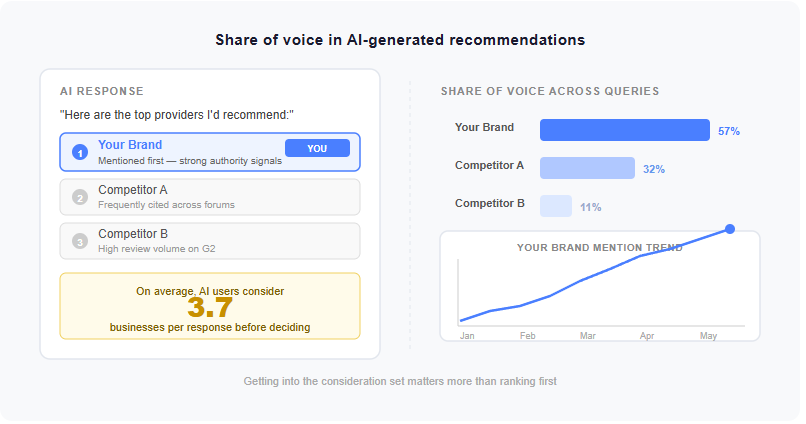
Research shows AI users consider an average of 3.7 businesses per response before making contact. Being first on that list is helpful, but being on the list at all is what truly matters. The goal isn’t to rank number one on ChatGPT. It’s to get into the consideration set consistently.
This is also why brand name mentions in link-building campaigns now carry more weight than keyword-anchored links. Those brand mentions feed directly into what LLMs recognize and reference. That’s share of voice being built at the foundation level.
Citation visibility
Citations are different from brand mentions. A citation is when an AI response includes a clickable link to your content as a source. Getting cited means the model sees your content as credible enough to reference directly.
Citation visibility matters because it’s one of the clearer signals that your content is actually influencing AI outputs. It’s also how some discovery happens. A user may not search for your brand, but they follow a cited link from an AI response and land on your site for the first time. For some businesses, more leads come in from people who discovered them through ChatGPT citations than from direct traffic originating in ChatGPT.
The websites already performing well in traditional search are the ones getting cited in AI results. Quality content, authoritative backlinks, and brand trust feed directly into citation visibility. The two aren’t separate disciplines.
Brand sentiment in AI responses
Getting mentioned is one thing. Getting mentioned positively is another. Brand sentiment tracks how your brand is framed when AI talks about it. Is it recommended? Mentioned neutrally? Paired with caveats and limitations? Visibility without good sentiment can actually damage trust rather than build it.
Pay close attention to reputational prompts like comparisons to competitors, best-vs-worst queries, and questions about alternatives. These are where sentiment is most explicit and most likely to influence whether a potential customer contacts you or someone else. If AI is consistently framing you as the second-best option, that’s something you need to know and act on.
Sentiment shifts can also signal changes in how your brand is covered across the web, which feeds directly back into what AI models absorb over time.
AI-driven traffic and downstream conversions
Once you’re being mentioned and cited, you need to know what happens next. AI-driven traffic tracks visits that originate from AI platforms, connecting your visibility metrics back to actual business outcomes like leads, signups, and purchases.
The right move is to separate traffic to high-intent pages like service pages and contact forms from informational blog traffic. The question isn’t whether total organic traffic went up. It’s whether the traffic that converts went up. If AI is sending people to your pricing page, that’s what you report to clients.
Keep in mind that about 60% of searches now end without a user clicking through to any website at all. AI-driven traffic metrics won’t tell you everything. They work best alongside mention visibility and share of voice, not as a replacement for them.
Rethinking how you report to clients
The underlying message from smart agency leaders is consistent: clients see traffic drop and assume everything is broken. The job right now is to reframe what success looks like.
Shift client conversations away from total organic traffic and toward the metrics above. Show where your brand appears in AI responses. Show whether it’s in the consideration set when someone asks for a recommendation in your category. Show the sentiment around the brand. Then connect all of it back to revenue, which is what clients actually care about.
The foundation hasn’t changed. Strong traditional SEO, quality content, authoritative backlinks, and brand trust signals like reviews and case studies, is still what gets you cited and mentioned in AI results. You’re not starting from scratch. You’re adding a new measurement layer on top of work that was already worth doing.
Leave a Reply