
If you’ve been doing SEO for long enough, you have most probably been a target of a negative SEO campaign. Whether it be an unscrupulous competitor or just a malicious actor on the internet, every website owner needs to have a playbook ready when the inevitable happens.
I’ll first go over the most common negative SEO tactics we’ve seen used, followed by proven ways you can stymie their harm on your search performance.
What is Negative SEO?
Negative SEO is the use of malicious tactics meant to harm a website’s presence on search results pages by making it seem like the target is breaking various policies. The goal is to harm another website’s presence as opposed to actually boosting their own.
The Most Common Negative SEO Tactics
While there are countless negative SEO tactics, the ones that you will most probably come across fall into these groups: spammy backlinking, link removal, content duplication, and negative PR.
Malicious Link Building with Spam
The most common malicious tactic is adding spammy links to the target website. Nowadays, building these spammy links can be automated and scaled by so-called botnet spam backlinking. This involves using compromised networks of devices to build hundreds and even thousands of toxic backlinks.
A quick Google search will reveal countless instances of businesses having their rankings tank because of this tactic.
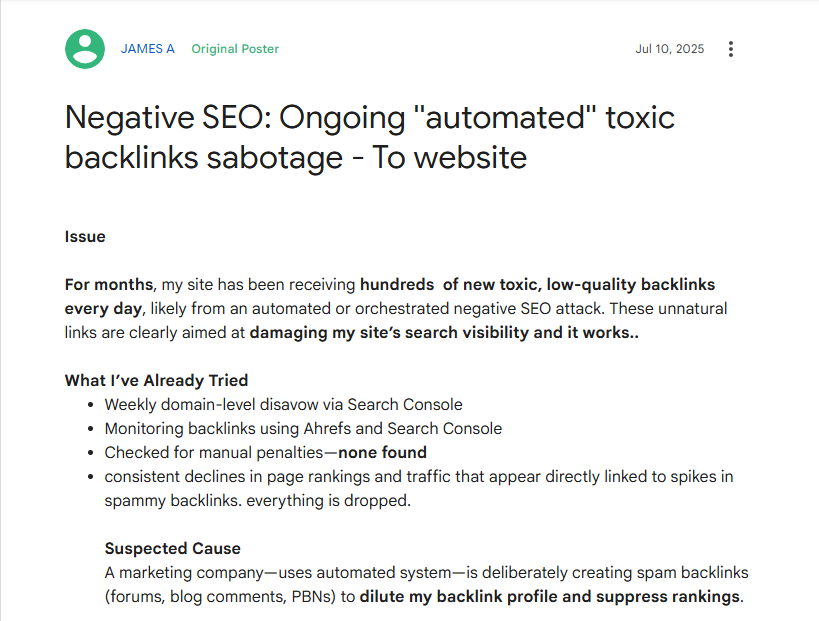
Unfortunately, the advice you’ll get from the SEO community won’t be that reassuring: you’ll read how Google’s anti-spam filters have already detected these spammy backlinks and ignore them. They will also say, to be fair, that a huge number of spam links can damage your rankings and even get your website penalized.
And this is a serious threat for smaller websites that may not have realized that they’ve been flooded with hundreds of spammy domains in a very short amount of time. This is because the ratio of high-quality (or at least real links) is heavily skewed in favor of spam. So, while SEOs will say that negative SEO via spammy links exists, it is super overrated and rare. But it’s very effective and fatal in one instance: with small websites because it appears to search engines that the nascent domain is buying links en masse to manipulate rankings.
So, my advice for small websites is to diligently check your backlink profile in Ahrefs and make sure that sketchy domains aren’t linking to you. If they are, consider adding them to a disavow file and monitor your performance. This becomes a pressing issue if this process becomes automated.
Different Types of Spam Links
The most common types of toxic backlinks are the following:
- Low quality PBNs (Private Blog Networks)
- Top-level domains
- Comment section spam
PBNs are basically link farms, which are networks of poor-quality websites designed for selling backlinks to boost rankings. Very little thought, if any, is given to editorial standards. YouTube, Fiverr, and LinkedIn are replete with accounts selling links from “websites with over 80 domain authority” for under $50.
Very often these websites don’t focus on one field, like cybersecurity, but will instead have various categories, from crypto to plumbing. And you’ll also notice that many of their pages aren’t indexed, which is another red flag.
Strange TLDs (Top-Level Domains)
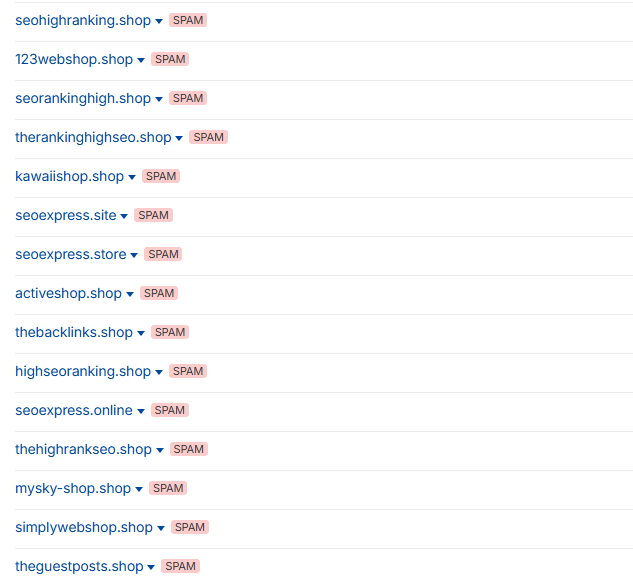
Also referred to as a domain extension, TLDS sites are those that end in .online, .xyz, .biz, and so on. Domains containing these endings don’t necessarily indicate the site is malicious, but many toxic domains do use them, so keep an eye out for them.
Comment spam
These are basically low-quality links placed in various comment sections and forums. People would just plop a link in a comment section of a blog post thinking they’re getting link juice.
Link Removal
We’ve discussed the harmful effect of spammy backlinks, but links from legitimate domains are one of the most important ranking factors. This is why some black hat SEOs analyze your backlink profile and then contact websites linking to you, impersonate you, and request that they remove the link.
It’s a sneaky way of weakening your backlink profile, and honestly, the only defense against this is to actively monitor your backlinks and get in touch with domains that remove their backlinks.
Content Scraping
This is another way of saying someone took your content and pasted it on a website they run. This may be done for a couple of different reasons. For one, the goal could be to get Google to penalize your website for using duplicate content. However, this really isn’t something that’s likely to happen because Google doesn’t really penalize identical content. One of the major reasons is that most duplicate content isn’t intentional.
The real goal behind this tactic is to outrank or push down the visibility of the original page by using their own content against them. Typically, Google will index identical content, but very often it won’t rank either page. But from a negative SEO perspective, that’s totally fine since the original website will lose rankings and visibility.
Negative PR
Smear campaigns are a common negative SEO tactic. Black hat SEOs will resort to things like writing fake negative reviews or using social media to lie about your brand and damage your credibility. It takes time to effectively counter these false claims, and it puts you on the defensive, which is never a good look. Unfortunately, smear tactics work and it takes time and resources to protect your image. The best way to prevent someone from tarnishing your brand’s reputation is to get in touch with review sites immediately and explain the situation. And of course, politely (but publicly) responding to these reviews can help protect your brand.
Social Engineering
This is one of the most egregious examples of negative SEO that I’ve ever heard. Well, it may not qualify as negative SEO (since it doesn’t really hurt anyone), rather it’s a black hat tactic but so unethical that I decided to add it here.
This tactic was used several years ago, and I don’t know whether it would be successful nowadays. The idea was to get in touch with a hospital or clinic with an offer to donate a medical device. However, the catch was that they were organizing a philanthropic event where participants would donate money toward the goal of buying the device. The only ask from the bad actor was to add a link from the hospital’s website (very often a high-authority website) to their website for awareness.
Of course, unsuspecting professionals at the medical facility would do so without a second thought. And of course, there was no raffle or crowdfunding event, and by the time they figured out what had happened, the black hat seo got their link juice.
Wrapping Up
The best way to fight against negative SEO is to be vigilant. Make sure that you perform regular backlink audits and that you monitor the search results page. And of course, make it a habit to look at your Google Search Console to be sure you haven’t been hit with any manual actions.
Leave a Reply